
· by Michael Blair, Nashville's Foundation Repair
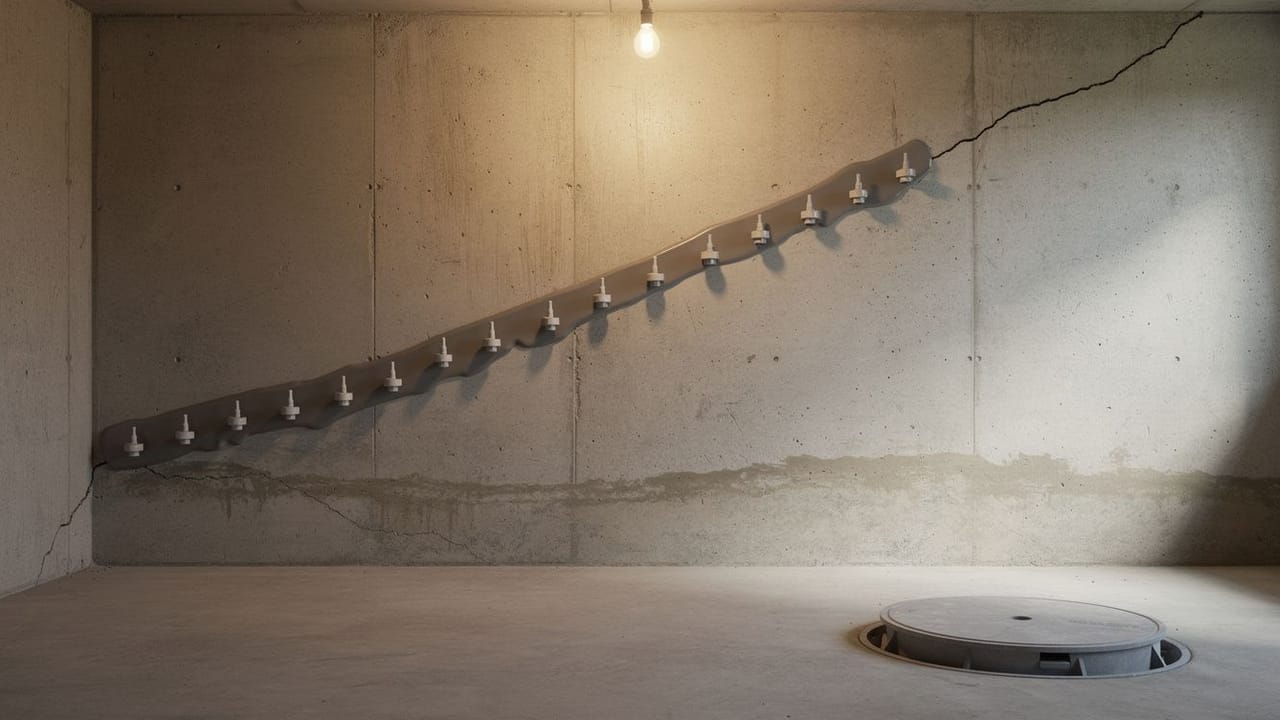
A crack in a poured basement wall is usually repaired by pumping a liquid resin into it through ports set along its length, and the resin is either an epoxy or a polyurethane. They are not two grades of the same thing. One is made to glue concrete back into one piece and the other is made to stop water, and a crack that gets the wrong one tends to open again or keep leaking. This post covers what each material does, which cracks suit which, and when injection is not the repair the wall needs. Our bowing and cracked walls page covers the wider range of work on basement walls.
What does epoxy injection do to a foundation crack?
Epoxy injection fills a crack with a rigid resin that bonds both faces of the concrete back together. Sika’s product data sheet for its Sikadur-52 crack injection epoxy (New Zealand edition) describes a two-part, low-viscosity epoxy made for crack injection, listing foundations and walls of residential buildings among the uses, along with structural bonding and keeping water out. Its own limits are just as specific: not into wet or saturated cracks, not into cracks under hydrostatic pressure, and not into cracks wider than 5 mm, which is a little under 3/16 inch.
The reason epoxy can make a cracked wall whole again is bond strength. An article in PCI’s ASPIRE magazine on evaluating and epoxy-injecting cracks in concrete explains that epoxy bonds to concrete more strongly than the concrete itself holds together in tension, so injection can restore a cracked section on cracks as fine as 0.002 inch. The same article describes the method: the face of the crack is sealed with an epoxy paste between surface ports, and injection starts at the lowest port and works up.
The catch is in that same article. Where movement of the concrete is expected after the repair, epoxy may not be the right answer. A rigid fill does not stretch, so a crack that keeps opening and closing will usually find a new line right beside the old one.
What does polyurethane injection do differently?
Polyurethane is injected to stop water, and it stays flexible after it cures. Sika USA’s data sheet for SikaFix HH Hydrophilic describes a polyurethane resin that expands quickly when it meets water and cures into a tough, flexible closed-cell foam, forming a gasket or plug in the crack. Unrestrained, it swells to six times its liquid volume, and the sheet credits its high elongation with keeping a tight seal in cracks that move.
Sika’s leak sealing brochure for its injection systems puts the two side by side. It calls epoxy a rigid material used for structural crack repair in dry and slightly damp conditions, and polyurethane a foaming resin that expands with water to block its passage. A polyurethane-sealed crack is watertight, but the concrete on either side has not been bonded back into one piece.
- Dry or damp crack, no longer moving, and the wall needs to act as one piece again: epoxy.
- Water running through the crack now, or a crack that still opens and closes with the seasons: polyurethane.
- Active leak in a wall that also needs its strength back: the water is stopped first, and the wall is assessed on its own terms.
When is injecting the crack the wrong repair?
Injection is the wrong repair whenever the thing that cracked the wall is still pushing on it. Resin seals the gap. It does nothing about clay swelling against the outside of the wall, a footing that is settling, or water building up in the soil after a week of rain. ASPIRE names corrosion of the reinforcing steel and expected movement as the cases where epoxy may not be the best solution, and the same thinking applies to any crack sealed while the cause is still active.
In Middle Tennessee the cause is usually the ground. Our post on what Middle Tennessee clay does to a foundation explains how the soil around a basement shrinks through a dry summer and swells through a wet winter, which is exactly the kind of repeated movement a rigid epoxy fill cannot ride out. A wall that is bowing inward, or a crack that is wider at one end than the other, is telling us about load on the wall, and that calls for wall repair with anchors or carbon fiber or a pier job before it is a crack repair. Water is the other cause. Sealing a crack from the inside while the yard still drains toward the wall just moves the leak somewhere else, which is why we look at drainage and grading on most wet basements.
There is a timing issue too. The Sikadur-52 sheet sets the injection and substrate temperature range at 5 to 30 °C, about 41 to 86 °F, so a cold unheated basement in January may need to be warmed before epoxy goes in.
How we decide what goes into a crack
We start by finding out whether the crack is still moving. Our post on tracking a foundation crack through the year shows how to mark its ends and measure its width so the seasons answer that question, and our post on which foundation cracks actually matter covers the patterns that point to trouble. A crack that has held the same width through a summer and a winter is a candidate for epoxy. One that keeps changing is not, until whatever is moving it has been dealt with.
Next is water. A crack that is dry or damp can take epoxy. One that is wet or seeping gets polyurethane, or gets its water problem solved outside the wall first. Then we look at whether the wall itself is straight, plumb and carrying its load, because a sealed crack in a wall that is still leaning inward has only been hidden.
Sika’s own literature says this resin work is for trained, experienced contractors, and the reason shows in the method: ports at the right spacing, a surface seal that holds under pressure, and resin pushed from the bottom up until it shows at the next port. If you have a crack and are not sure which it is, send us a photo and a description and we will tell you what we would want to see.
Sources
- Sika, Sikadur-52 Injection Normal Product Data Sheet (New Zealand edition, March 2026) — What epoxy crack injection is for, its limits (no wet, saturated or hydrostatically loaded cracks, 5 mm maximum width) and its 5 to 30 °C application range
- Sika USA, SikaFix HH Hydrophilic Product Data Sheet — Hydrophilic polyurethane that foams on contact with water into a flexible seal, expands to six times its volume, suits moving cracks
- Sika USA, Leak Sealing Solutions with Sika Injection Systems — Epoxy as a rigid structural injection for dry and slightly damp cracks, polyurethane as a water-blocking foam, work by trained contractors
- PCI ASPIRE, Evaluation and Epoxy-Injection Repair of Cracks in Concrete (Winter 2018) — Epoxy bond strength exceeds concrete tensile strength, cracks from 0.002 inch, the injection method, and why expected movement or corrosion rules epoxy out
FAQ
Foundation Crack Injection: Epoxy or Polyurethane — questions
Can a foundation crack be repaired with epoxy injection?
Yes, when the crack has stopped moving and is dry or only damp. Epoxy bonds the two sides of the concrete back together, and it can work on very fine cracks. It is the wrong choice for a crack that is wet, under water pressure, wider than the resin’s limit, or still opening with the seasons.
What is the difference between epoxy and polyurethane crack injection?
Epoxy cures rigid and bonds the concrete back into one piece, so it suits a stable crack that needs its strength restored. Polyurethane foams when it meets water and cures flexible, so it suits a crack that is leaking or still moving. One restores the wall, the other stops the water, and neither does both jobs.
Does epoxy injection stop a foundation crack from coming back?
Only if whatever cracked the wall has stopped. Epoxy does not stretch, so in a wall that clay keeps pushing on through the year, the concrete usually cracks again next to the repair. That is why we watch a crack through the seasons, and fix any movement or drainage problem, before sealing it with epoxy.
Can you inject a foundation crack that is leaking water?
Yes, but not with epoxy. A crack with water running through it, or water pressure behind it, calls for a hydrophilic polyurethane that expands on contact with water into a flexible seal. It is still worth asking why water is reaching the wall, because a yard that drains toward the house will find another way in.
Does injecting a crack fix the cause of the crack?
No. Injection seals the gap in the concrete and nothing else. If the crack came from settling footings, swelling clay, a wall bowing under soil pressure or poor drainage, that cause is still there after the resin cures. The cause gets fixed first, or alongside, and the crack is sealed as the last step.