
· by Michael Blair, Nashville's Foundation Repair
Drain tile is the pipe nobody sees until a basement starts taking water at the bottom of the wall. It runs along the footing, below the floor, and its job is to give groundwater an easier path than through the foundation. When it clogs, breaks or loses its outlet, the water goes back to its old route. Here is what the code asks of a footing drain, how we tell one has stopped working, and what repairing it involves, from outside the wall or from inside the basement.
What is drain tile, and what does it do?
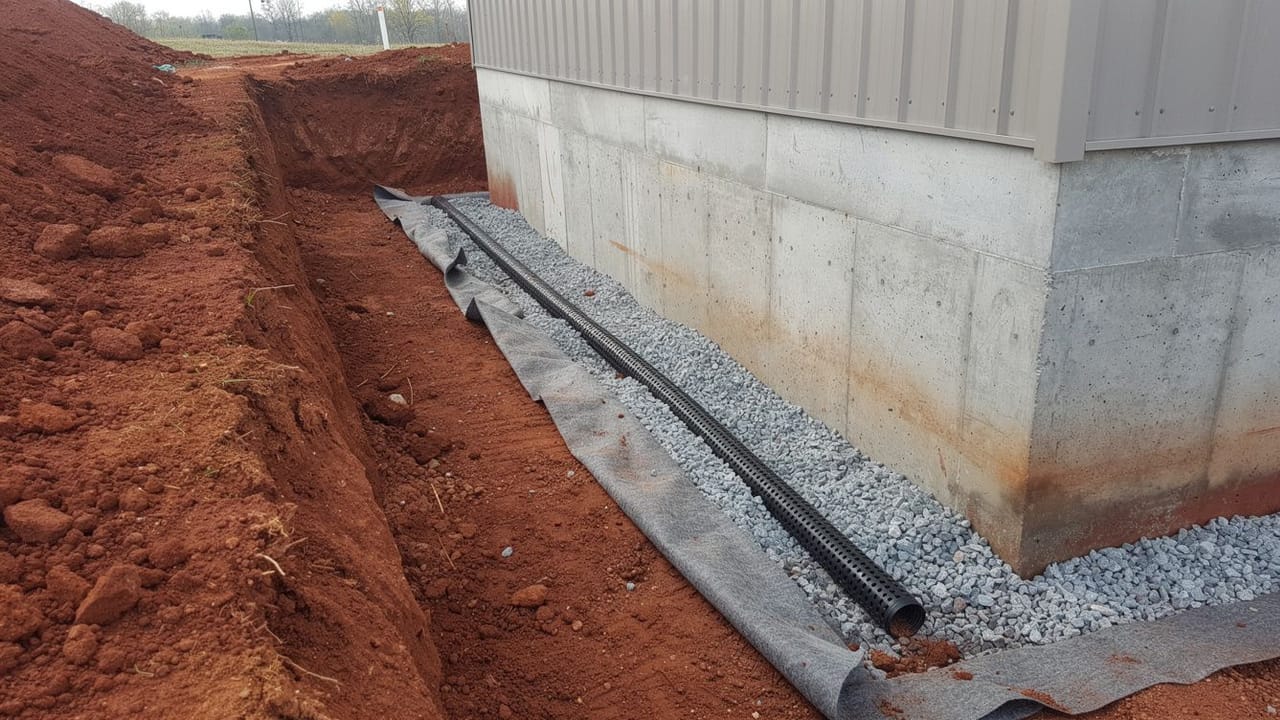
Drain tile is a perforated drain laid at the foot of a basement wall that collects water from the soil around the footing and carries it to a sump or to daylight before it can build up against the foundation. The name is older than the material. The first ones were short clay pipes laid end to end, and the code still mentions covering the open joints of drainage tiles with strips of building paper. Today it is almost always perforated plastic pipe.
The 2018 International Residential Code, Section R405.1, as published for Tennessee, requires drains around concrete or masonry foundations that hold back earth and enclose living or usable space below grade. The pipe goes at or below the top of the footing, rests on at least 2 inches of washed gravel, is covered by at least 6 inches more, and has a filter membrane keeping soil out of the stone. It has to empty, by gravity or by a pump, into an approved drainage system.
The code lets a house skip the drain only on well-drained gravel and sand, the soils its table puts in Group I. The clays common around Nashville sit outside that group, which is why we expect a footing drain on a basement here, and why its failure shows up as water.
How can you tell a footing drain has failed?
A failed footing drain usually shows itself as water at the joint where the basement wall meets the floor, arriving with heavy or long rain, while the outlet the drain is supposed to feed stays dry. Where the water appears matters. A damp line along the bottom of the wall points to the drain and the soil around the footing; water at one crack, or over the top of the wall, points somewhere else, a difference we cover in water in a Nashville basement.
The Building America Solution Center’s footing drain guide names the usual causes. Silt, sand and debris fill the pipe, most often where it was never wrapped in fabric or was bedded in gravel that carried fines. Roots work in. Landscaping or a later dig cuts or crushes the pipe, so it no longer runs around the whole footing. And some drains were simply ended badly and never carried water anywhere useful.
To find which, we start at the outlet. We locate where the drain is meant to discharge, a pipe at daylight or a sump pit, and check that water can leave. Where there is a cleanout or an open end, running water through it, and a drain camera where one fits, shows whether the pipe is clear, silted or broken, and roughly where.
Can old drain tile be repaired, or does it need replacing?
Old drain tile can sometimes be cleared or repaired in sections, but a drain that is silted along its length, crushed, or missing in places usually has to be replaced, outside the wall or inside the basement. A clog near an open end can be flushed. A short run broken by a later dig can be cut out and spliced. A pipe that filled with soil because nothing filtered the water around it will fill again, because its bedding has not changed.
Before replacing anything, the footing drain guide says to deal with the water sources first: gutters and downspouts, plumbing leaks, gaps and cracks in the foundation, ground that runs toward the house, and patios, walks and driveways that slope the wrong way. We agree, because a new drain asked to carry a downspout’s worth of roof water does not last.
Replacing it from outside means digging down to the footing, laying new perforated pipe in clean gravel with fabric around it, and giving it a working outlet. The guide calls that labor-intensive, and points out that waterproofing or insulation added while the wall is open costs comparatively little. Replacing it from inside means cutting a strip of the basement floor along the wall, laying pipe in gravel beside the footing and running it to a sump. Our basement waterproofing page explains how we choose between the two.
Where does the water go once it reaches the drain?
Water in a footing drain goes either to daylight through solid pipe or to a sump pit, where a pump lifts it out, and both ends need as much care as the pipe itself. The footing drain guide asks for a solid discharge pipe that falls the whole way and empties at least 10 feet from the foundation, or, from a sump, a discharge line that falls at least half an inch per foot for 10 feet before it reaches daylight or another approved outlet.
For a sump added to an existing basement, the Building America guide to retrofitting a drain or sump connects the pit to the perimeter drain or the gravel under the slab, digs the hole 6 to 10 inches deeper and wider than the liner, and calls for a gasketed cover fastened down. An open pit lets soil gases into the house, radon among them. The discharge gets a check valve so water cannot run back, and it ends somewhere other than beside the foundation, where it would soak in and return.
The same guide asks for a check for asbestos, lead and similar hazards before digging in an older house, since the work disturbs what is already there. Outside, the drain’s outlet often ties into the yard’s drainage and grading, and whether the house is in Green Hills or anywhere else we work, that outlet is the first thing we look for. If water is showing up at the bottom of your basement wall, ask us to come and look.
Sources
- 2018 International Residential Code as published for Tennessee, Section R405.1 Foundation Drainage (UpCodes) — Drains required around concrete or masonry foundations enclosing space below grade; placement at or below the top of the footing; 2 inches of gravel under the pipe and 6 inches over it; filter membrane; Group I soil exception.
- Building America Solution Center, Footing Drain Pipe — Causes of failure (silt, roots, cut pipe, poor termination); fix water sources first in existing homes; daylight discharge at least 10 feet out; sump discharge falling at least 1/2 inch per foot for 10 feet.
- Building America Solution Center, Drain or Sump Pump Installed in Basements or Crawlspaces — Retrofit sump connected to the perimeter drain; pit 6 to 10 inches larger than the liner; gasketed, fastened cover against soil gases including radon; check valve; hazardous materials check first.
FAQ
Drain Tile Repair: When a Footing Drain Stops Working — questions
What is involved in drain tile repair?
Repair starts at the outlet: finding where the drain discharges and whether water can leave. A clog near an open end can be flushed and a short broken run spliced. A drain that has silted along its length or been crushed is usually replaced, by digging outside to the footing or by cutting a strip of the basement floor.
How deep should drain tile be around a basement?
Section R405.1 of the International Residential Code sets a foundation drain no higher than the top of the footing, or else beneath the floor slab. The pipe sits on at least 2 inches of washed gravel and is covered by at least 6 inches more, with a filter membrane keeping the surrounding soil out of the stone.
Why is it called drain tile?
Because the first foundation drains were short clay tiles laid end to end, with small gaps between them where water could enter. The name stayed after perforated plastic pipe replaced clay. The building code still carries the old detail, asking that the open joints of drainage tiles be covered with strips of building paper.
Does basement drain tile need a sump pump?
Only where the drain cannot fall to daylight. The code lets a footing drain discharge by gravity or by mechanical means. On a sloping lot, solid pipe can carry the water at least 10 feet from the foundation. On a flat lot or a deep basement, the drain runs to a sump pit and a pump lifts it out.
Why does drain tile clog?
Mostly silt. Soil carried in with the water settles inside the pipe, especially where the drain was never wrapped in filter fabric or was bedded in gravel that contained fines. Roots get in as well, and a pipe cut by a later dig stops draining past the break. A drain that clogged for lack of fabric will clog again.