
· by Michael Blair, Nashville's Foundation Repair
When a corner of a house drops or a hole appears in the yard, the word sinkhole comes up quickly around here, and for a reason: much of Middle Tennessee is built on limestone. Most of the movement we look at is something more ordinary, the soil under the footings shrinking, swelling or compressing, which our post on clay soil and foundations covers. A sinkhole is a different failure with a different cause, and it changes who should look at the ground before anyone talks about foundation repair. Here is how the U.S. Geological Survey describes it.
Why is Middle Tennessee limestone country?
Because much of the state is underlain by rock that water can dissolve. A 2026 USGS data release on karst areas in middle and east Tennessee says about 43.5 percent of Tennessee is underlain by karst or by rocks that can form karst, and names the Highland Rim and the Central Basin among the sections underlain by carbonate rock from the Cambrian to the Mississippian periods. Karst is the landscape that forms where that rock has been worked by flowing water for a very long time.
The USGS Water Science School’s page on sinkholes explains the mechanism. Groundwater moving through limestone and other carbonate rock dissolves it, leaving spaces and caverns underground, and the land over them can stay intact for a long while before it gives way. The same page lists Tennessee among the states where sinkholes do the most damage, along with Florida, Texas, Alabama, Missouri, Kentucky and Pennsylvania. It also says sinkholes rarely happen. Neither source gives a count for Nashville or any one county.
Is it a sinkhole or ordinary settlement?
Usually settlement, and the difference is where the failure starts. Settlement is the soil under the footing moving: clay shrinking as it dries, or loose fill compressing under the load. The house shows it in cracks and in doors and windows that bind, and our post on which foundation cracks matter goes through those. A sinkhole starts deeper, in the rock, and reaches up through the soil to the surface.
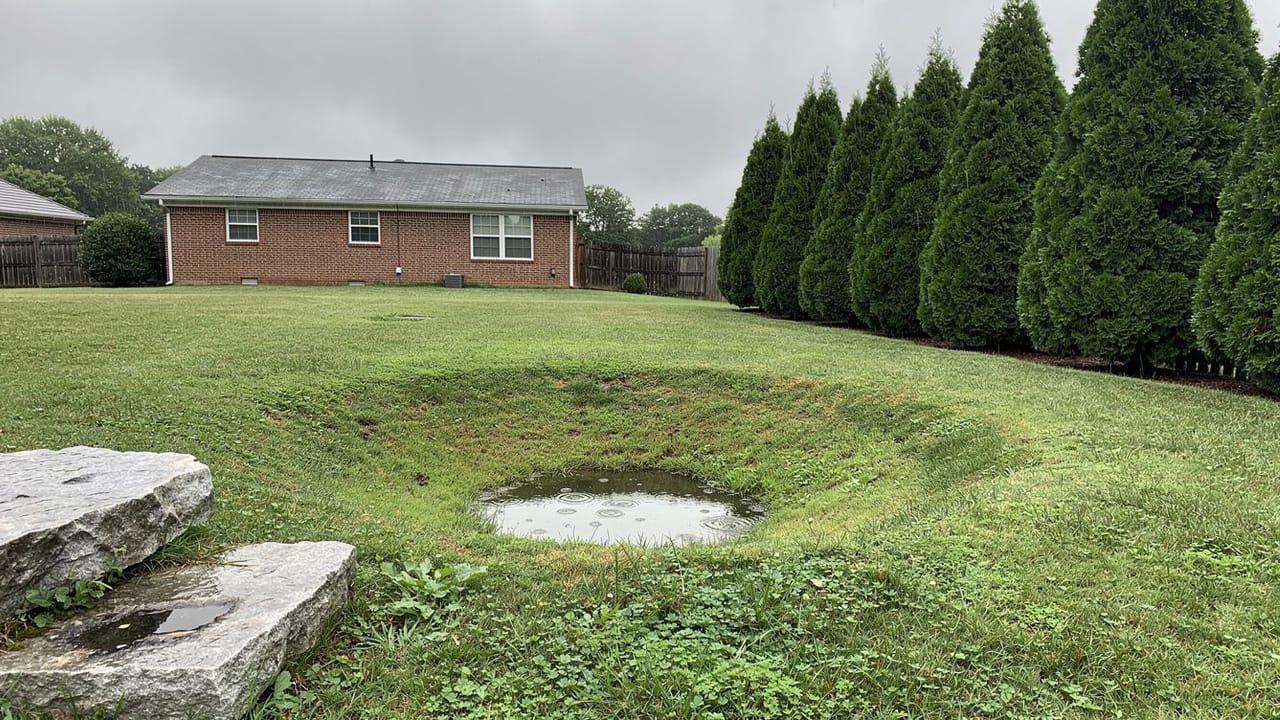
From inside the house the two can look alike, so the evidence that matters is outside. USGS defines a sinkhole as a depression in the ground with no natural surface drainage: rain that falls into it stays there and drains down into the ground instead of running off. Sinkholes range from bowls and saucers to holes with vertical sides, and some hold water as ponds. A crack you can measure over a year is a settlement question. A hole that opened in the yard, or a low spot near the house that takes water down rather than away, is a question about the ground under it.
Slow or sudden: how karst ground gives way
USGS describes two kinds of sinkhole that form through a covering layer of soil, and the soil decides which one you get. Cover-subsidence sinkholes develop gradually, where the cover is permeable and sandy; where the cover is thicker or holds more clay, they are less common, smaller and can go unnoticed for a long time. Cover-collapse sinkholes form where the cover contains a significant amount of clay, and USGS says they may open abruptly, over a period of hours, and cause catastrophic damage.
People can set them off, too. USGS ties new sinkholes to groundwater pumping, to construction and development, and to changes in the natural pattern of drainage, including new systems that move water somewhere it did not go before. The weight of new material placed on the ground can trigger a collapse of what was holding it up. In karst country, where water is sent and what is built over it are part of the same question.
Who should look at it first?
If there is a hole or a fresh depression, a geotechnical engineer or a geologist should look before a foundation contractor does. Whether the cause is in the rock is their call, and so is how the ground is repaired. We do not drill or fill sinkholes. Part of what they read is already mapped: the Tennessee Geological Survey has published or released more than 500 of the state’s 804 geologic quadrangle maps, and the survey says that work includes information on geologic hazards such as caves, landslides and sinkholes.
Our foundation inspection looks at how the house itself has moved, which is the right first step when the evidence is cracks, sloping floors and sticking doors with no change in the ground outside.
Insurance treats these causes differently, which our post on insurance and foundation movement explains, so the name on the cause matters for that reason as well. If you are in Nashville, Donelson or the towns around it and are not sure which kind of problem you have, send us photos of the house and the yard. We will tell you plainly whether it is ours to look at or an engineer’s first.
Sources
- U.S. Geological Survey, Water Science School: Sinkholes — Definition (a depression with no natural external surface drainage); formation in limestone and carbonate rock; most damage in Florida, Texas, Alabama, Missouri, Kentucky, Tennessee and Pennsylvania; sinkholes rarely happen; cover-subsidence gradual in sandy cover; cover-collapse abrupt, over hours, where cover has significant clay; human-induced causes; no national database of collapses.
- Tennessee Department of Environment and Conservation, Tennessee Geological Survey: Geology Programs — 804 quadrangles cover Tennessee, 517 mapped and published or released since 1960; its mapping includes information about geologic hazards such as caves, landslides and sinkholes.
- Hourigan and others, 2026, Karst areas of high conservation value in middle and east Tennessee, USGS data release (ScienceBase) — About 43.5 percent of Tennessee underlain by karst or rocks with the potential to form karst; Highland Rim and Central Basin underlain by Cambrian to Mississippian carbonate units. https://doi.org/10.5066/P1BVZRNT
FAQ
Sinkhole or Settlement Under a Nashville House — questions
Are there sinkholes in Nashville?
The U.S. Geological Survey names Middle Tennessee’s Central Basin and Highland Rim among the parts of the state underlain by carbonate rock, the kind that dissolves and forms sinkholes, and lists Tennessee among the states with the most sinkhole damage. Neither USGS source gives a count for Nashville or Davidson County.
Can a sinkhole damage a house foundation?
Yes. USGS says a collapse can happen where a house or road sits on top, and that cover-collapse sinkholes, which form where the soil over the rock holds a lot of clay, can open over hours and cause catastrophic damage. USGS also says sinkholes rarely happen; most foundation movement is the soil itself.
What causes sinkholes in Tennessee?
Groundwater slowly dissolving limestone and other carbonate rock, leaving open spaces underground until the ground above can no longer bridge them. About 43.5 percent of Tennessee is underlain by karst or rock that can form it. USGS adds that pumping, construction, new weight and changed drainage can trigger new sinkholes.
Are sinkholes common in Tennessee?
Tennessee is one of seven states USGS lists as having the most sinkhole damage, and a 2026 USGS data release puts about 43.5 percent of the state on karst or rock that can form it. USGS also says sinkholes rarely happen and that no national database tracks collapses, so numbers are hard to find.
Can a sinkhole under a house be repaired?
That is a question for a geotechnical engineer, who works out what the ground is doing and how to stabilize it. We do not drill or fill sinkholes. Once the ground is understood, a foundation contractor can deal with how the house itself has moved, and an inspection shows what that movement is.